
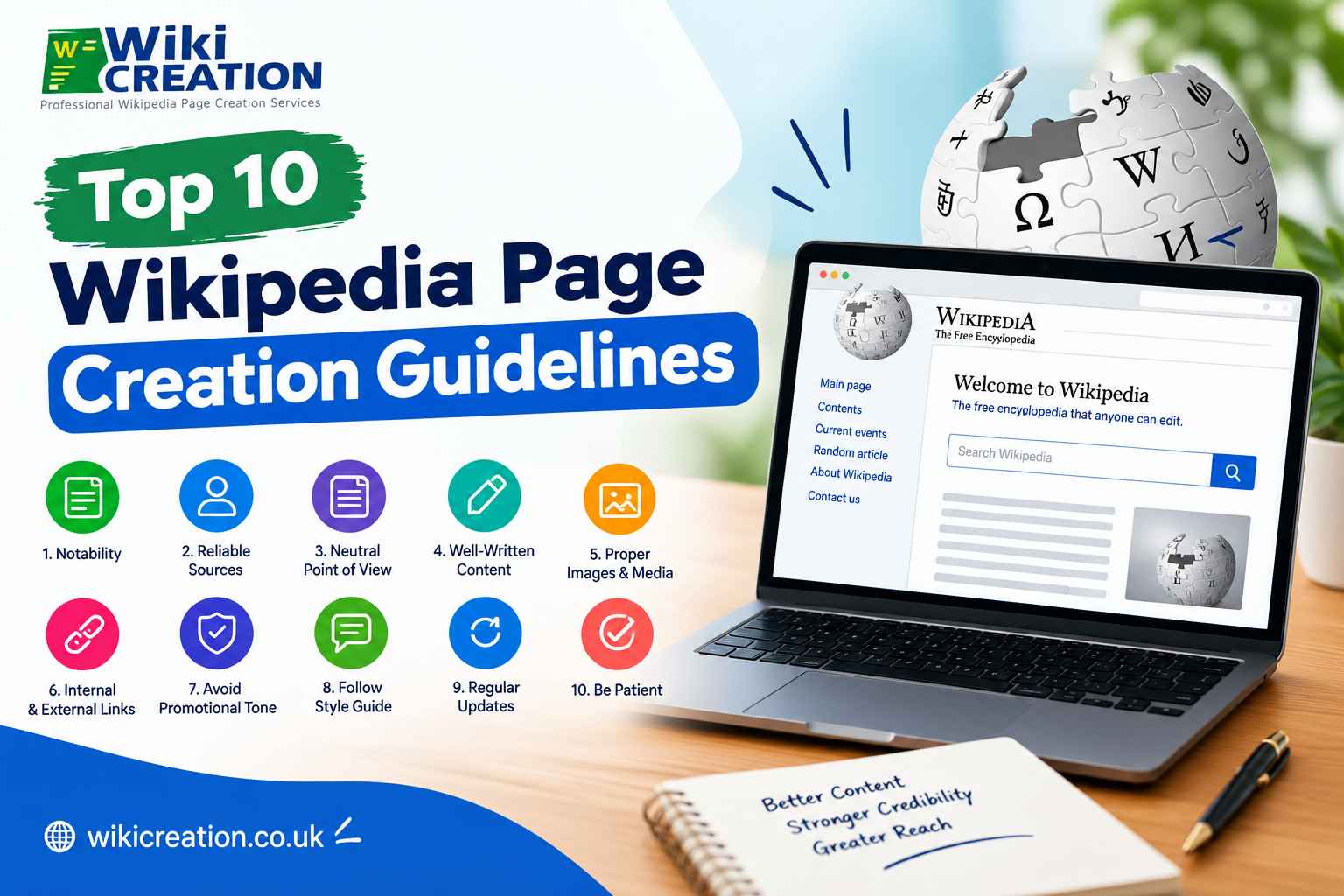
Top 10 Wikipedia Page Creation Guidelines
Creating a Wikipedia page involves considerably more than writing an interesting profile and publishing it online. Before preparing an article, it is important to determine whether the subject meets Wikipedia’s requirements, particularly its notability and sourcing standards. A page must be supported by suitable sources and written for an encyclopaedic purpose rather than as promotional material.
Knowing the Wikipedia page creation guidelines is important because the only Wikipedia page that survives today is one that easily passes the review process and demonstrates neutrality.
Scroll down to learn about the core rules of the Wikipedia page creation.
What You Need To Prepare Before Creating A Wikipedia Page
Wikipedia operates in a very different way. It is not a conventional publishing platform where a business can submit an article and automatically have it approved.
Wikipedia’s own guidance stresses that only a few factors can influence whether content belongs in the encyclopaedia or not.
Here is what you need to keep in mind to create a Wikipedia page that lasts.
1. The Subject Should Meet Wikipedia’s Notability Requirements
Notability should be considered and assessed with the help of Wikipedia notability services before any writing begins.
Wikipedia generally looks for significant coverage of a subject in reliable, independent sources. Being well known within a particular organisation does not automatically establish encyclopaedic notability.
The sources should discuss the subject in meaningful detail rather than simply mentioning its name.
Wikipedia’s guidance also distinguishes independent coverage from material produced by the subject itself.
The following sources do not count towards a subject’s notability:
- Company websites
- Press releases
- Advertising
- Self-published material
2. Find Reliable, Independent Sources
Once notability appears possible, gather the sources that will support the proposed article.
Useful sources can include
- Established newspapers
- Books from reputable publishers
- Academic publications
- Other editorially controlled publications.
A collection of social media posts, directory listings or company announcements is unlikely to provide the same foundation.
It is also important to assess each source individually. A publication may be genuine but still provide only a brief mention of the subject, which may not be enough to establish significant coverage.
3. Avoid Promotional Language
Wikipedia articles are expected to have an encyclopaedic tone. Descriptions such as “leading”, “world-class”, “highly respected” or “industry-leading” can make an article sound like marketing copy when they are not directly supported by appropriate sources.
A better approach is to state verifiable facts and allow readers to form their own conclusions.
4. Always Disclose Conflicts Of Interest
A conflict of interest can arise when someone has a personal or financial connection with the subject of an article.
Wikipedia strongly discourages people with conflicts of interest from directly editing affected articles.
Paid contributors must also disclose their employer, client and affiliation.
If a company believes an article needs to be created or improved, using appropriate discussion is generally safer than treating Wikipedia like a conventional company website.
5. Start In The Wikipedia Sandbox
Starting with a draft provides an opportunity to develop the article structure and identify problems before the material reaches the main encyclopaedia.
Wikipedia’s current guidance also provides tools designed to help newer contributors assess notability and conflicts of interest.
The Article Wizard can guide you through questions before you start creating a draft. Drafting first can also make it easier to receive feedback and correct sourcing problems.
6. Ensure That The Translations Follow The Platform Guidelines
Each language edition has its own editorial community policies and expectations, so a translation should still be reviewed for accuracy, neutrality, sourcing and formatting after the language has changed.
A specialist translator from Wikipedia translation services can help preserve the meaning of the original article while adapting references and formatting appropriately for the target-language edition.
Before a translated page is submitted or published, it is useful to check:
- Does the translated content accurately reflect the original source?
- Whether citations are relevant and correctly formatted.
- Does your wording follow the target Wikipedia edition’s style?
- Does the article maintain a neutral and encyclopaedic tone?
You should aim to create a version that reads naturally in the target language without losing the sourcing and context expected by the platform.
7. Set A Neutral Tone
Neutrality is one of the fundamental principles behind Wikipedia’s editorial approach. An article should not be written as though it were a company’s biography or promotional brochure.
This means
- Significant viewpoints may need to be represented fairly when reliable sources discuss them.
- Positive and negative information should not be selectively included simply because one version is more favourable to the subject.
Neutrality does not mean that every opinion receives equal space. The amount of attention given to a viewpoint should reflect the quality and significance of the available sources.
8. Verify Your Claims
Information included in a Wikipedia article should be capable of being checked against published sources. This becomes important when an article contains dates, statistics, claims about achievements or statements about people.
Always where every important factual statement came from before adding it to a draft.
If a claim cannot be supported, it may need to be removed or rewritten.
Wikipedia’s approach places considerable importance on verifiability rather than asking editors to establish facts through their own research.
9. Research the Article’s Structure
A Wikipedia article normally works best when information is arranged logically rather than presented as a long block of text.
Depending on the subject, a page might include sections covering its history, career, products, publications, activities or other relevant areas.
The structure should reflect what reliable sources actually say about the topic.
Avoid creating sections simply to make an article appear longer as every section should serve a clear encyclopaedic purpose.
10. Don’t Copy Material From Other Websites
Even when information is factually accurate, copying text creates copyright concerns and can make the article unnecessarily dependent on one source.
Instead, information should be summarised in original wording while properly attributing the underlying sources.
The same principle applies to photographs and other media. Images require appropriate licensing or another valid basis for use on Wikipedia.
Solutions To Common Questions
- How many sources do we need for a Wikipedia page?
There is no fixed minimum number of sources required. It all depends on the quality and independence of coverage.
- Can a company create its own Wikipedia page?
While a company can be involved in the process, the conflict-of-interest policy does not allow the subject matter to contribute directly due to the direct involvement in the topic. Paid contributors must disclose their relationship, and direct promotional editing should be avoided.
- Is it enough just to translate the existing Wikipedia article?
It is not enough. Different language versions have different policies, and even though you translated the article, you still have to follow the rules of the specific Wikipedia version.
Wrapping Up
Succeeding in making a page on Wikipedia is something that begins far before pressing the “Publish” button. The best form of preparation includes making sure of the notability of your content, finding independent sources, and making sure you understand conflict of interest and neutrality issues.
An extremely well-written draft may still be changed by the Wikipedia community; therefore, there are no guaranteed ways to get your page approved. The only thing that helps is to view Wikipedia as an encyclopedia and not a marketing tool.

At WikiCreation.co.uk, I guide readers through the process of creating the best Wikipedia pages. My post dives into research, compliance with Wikipedia guidelines, and strategies for online reputation management. I help public figures, businesses, and professionals understand how a well-crafted Wikipedia profile can enhance credibility, reach wider audiences, and strengthen their digital profile.